How Much Does a Business Website Cost in the UK?
If you have asked for website quotes recently, you already know the problem: the numbers are all over the place. One freelancer quotes £800. An agency asks for £15,000. Neither tells you what you are actually getting, and neither makes it easy to compare.

This is a genuine breakdown of how much a business website costs in the UK in 2026, where the money goes, and how to read a quote without getting misled.
How much does a business website cost in the UK: the real ranges
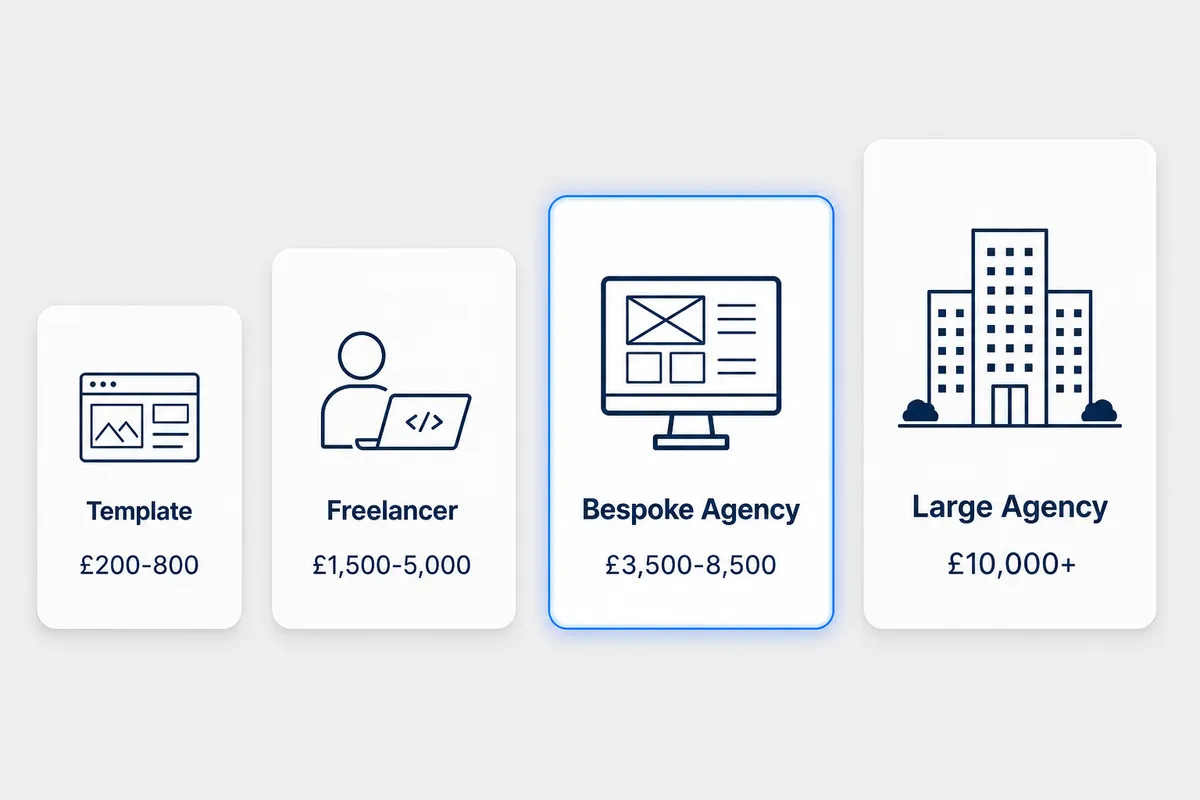
UK business website costs fall into four broad tiers. The price depends on who builds it, what is included, and whether the site is a template adaptation or a bespoke build.
Tier 1: Off-the-shelf (£200 to £800)
This is a pre-purchased theme installed on WordPress, Squarespace, or Wix. You supply your own content, images, and logo. The builder sets up the theme, connects your domain, and hands it over.
What you get: a functional site that looks like the template demo. Limited customisation. No strategic input. You are responsible for content, performance, and ongoing maintenance.
This tier works for a side project or a micro-business that just needs a web presence. It does not work for an established firm that relies on the site for enquiries.
Tier 2: Freelancer build (£1,500 to £5,000)
A solo designer or developer builds a site, usually on WordPress or a page builder. The deliverable is typically five to ten pages with basic SEO, a contact form, and mobile responsiveness.
At the lower end of this range, you get a template-based build with your branding applied. At the upper end, you might get a custom design, some copywriting support, and basic analytics setup.
The risk with freelancer builds is scope clarity. A quote of £2,000 often becomes £4,000 once you add the pages, revisions, and integrations that were not in the initial brief. Ask for a fixed-scope proposal, not an hourly estimate.
Tier 3: Specialist agency (£3,500 to £8,500)
A niche agency or a senior team builds a bespoke site with commercial strategy, copywriting, proper measurement, and a defined process. The deliverable is not just a website: it is a customer acquisition asset.
At this level you should expect a discovery phase (understanding your customers and commercial objective), copy developed from customer interviews, a custom design (not a template), hand-coded implementation, analytics and conversion tracking, and a post-launch review.
This is where LeadBuilt operates. Projects are fixed-scope with transparent pricing:
- LeadBuilt Core, £3,500: Up to five bespoke pages, one visual direction, one primary enquiry journey, technical SEO, analytics setup, and a 30-day defect warranty. Timeline: around three to four weeks.
- LeadBuilt Growth, £5,500: Up to ten pages, copy developed from a recorded customer interview, CRM integration, two landing pages, migration of up to 25 redirects, and a 30-day post-launch data review. Timeline: around four to six weeks.
- LeadBuilt Demand, from £8,500: Search-led architecture, up to 18 launch pages, competitor research, one interactive tool (calculator or assessment), advanced integrations, and a 90-day search and conversion review. Timeline: around six to eight weeks.
All packages include a founding-stage business session, two revision rounds, and proper consent-aware analytics from day one.
Tier 4: Large agency (£10,000 to £50,000 plus)
Full-service agencies with account managers, multiple design rounds, brand strategy, photography, and video. You are paying for the team size and the process overhead as much as the output.
These builds suit organisations with multiple stakeholders and complex procurement requirements. For most established UK service firms (trades, professional services, consultancies), the additional cost rarely translates into additional enquiry generation.
What drives the cost difference: the five variables
When comparing website quotes, the price difference between two options is almost always explained by five things. Understanding them prevents you from paying agency prices for a freelancer build or accepting freelancer limitations at an agency price.
1. Discovery and strategy
A proper build starts with understanding your customers, your commercial objective, and what a conversion looks like for your business. This phase produces the sitemap, messaging framework, and page-level briefs that guide the build.
Builds without discovery tend to produce visually acceptable sites that do not generate enquiries. The design might look polished, but the structure does not match how your customers make buying decisions.
2. Copywriting
The words on the page determine whether someone enquires or leaves. Professionally written copy, informed by customer interviews and designed around a conversion structure, costs more than client-supplied text. It also converts more.
Most agency and freelancer quotes exclude copywriting. The client writes the words, the builder places them. The result is pages that describe what the business does rather than addressing what the customer needs to know before making contact.
LeadBuilt Growth and Demand include copy developed from customer conversations. Core includes editing and structuring your supplied copy into a conversion format.
3. Design: bespoke versus template
A template adaptation starts with an existing design and swaps in your branding, images, and content. Customisation is limited to what the template supports. The site will look similar to other businesses using the same template, and you may be constrained by the template’s page structures and layout options.
A bespoke design starts from your commercial objective and builds outward. Every layout decision serves the enquiry journey. Bespoke coding means no template constraints on performance, accessibility, or page structure.
LeadBuilt sites are designed and coded from scratch. No purchased themes, no page builders, no template marketplaces.
4. Functionality and integrations
A brochure site with a contact form and five pages costs less than a site with CRM integration, a booking system, a resource centre, search-optimised landing pages, and analytics event tracking.
Be specific about what you need the site to do. If you say “a simple site” but later ask for a client login, a booking calendar, and integration with your email platform, the scope has changed and the price will change with it.
5. Maintenance and hosting
The build price covers creation, not operation. Hosting, SSL certificates, software updates, security patches, and performance monitoring are ongoing costs. Most freelancers hand the site over and you are responsible for everything after launch. Some agencies charge monthly retainers that include hosting plus a set number of update hours.
LeadBuilt Care starts at £59 per month and covers managed hosting, SSL, backups, uptime monitoring, dependency updates, security checks, monthly performance reports, and email support.
How to read a website quote
When you receive a proposal, check these six things:
-
Is the scope fixed? A fixed-scope proposal tells you exactly what you will receive and what it costs. An estimate with a day rate is an invitation to scope creep.
-
Is copywriting included? If not, factor in the time and cost of writing the pages yourself or hiring a copywriter separately.
-
Is the design bespoke or template-based? “Customised” usually means a template with your colours. “Bespoke” or “custom” means designed from scratch. Clarify which one you are paying for.
-
What happens after launch? Ask about hosting, maintenance, and update costs. A £3,000 build that costs £200 per month to host and maintain is a different equation than a £3,500 build with managed hosting included.
-
Do you own the code? If the site is built on a proprietary platform or a page builder, you may not own the finished product. You are renting access to it.
-
Is measurement included? A site that does not track enquiries, form submissions, or calls cannot tell you whether it is working. Analytics setup should be part of the build, not an add-on.
Getting a clear recommendation for your business
The best way to understand what your website should cost is to get a proposal based on your actual requirements rather than a generic price list. The LeadBuilt Website Blueprint is a £295 recorded strategy session that produces a written plan covering your commercial positioning, recommended sitemap, conversion structure, and a fixed-scope build recommendation. The £295 is credited against any LeadBuilt website commissioned within 30 days.
Alternatively, use the 3-minute project form to tell us about your business. You will receive a fixed-scope recommendation and a personal response within one working day. No obligation.
Get a fixed-scope recommendation for your business
Tell us about your project and receive a personal response within one working day. No obligation, transparent pricing from £3,500.